
BUILD-OPERATE-TRANSFER
Build your India engineering capability. Own it when you're ready.
Build and operate a dedicated ODC development center in India with NetSet Software while preparing a clear path to long-term ownership. You retain control of product and engineering direction. We manage the agreed local operating layer until your organisation is ready to take it on.
Build with local support today. Transition to your own operation tomorrow.
- Your Engineering Control
- Defined Ownership Path
- Transfer Readiness
- Full-Cycle Economics
NetSet Software at a glance
Quality & security
Certified & appraised
- CMMI Level 3Process maturity
- ISO 27001Information security
- ISO 12207Software lifecycle
- ISO 9001Quality management
THE CLIENT BENEFIT
Start with local support.Build
long-term ownership.
BOT is an ODC model outsourcing approach that lets you establish engineering capability in India without building every local function on day one. NetSet Software helps build and operate the model while your organisation prepares to assume ownership.
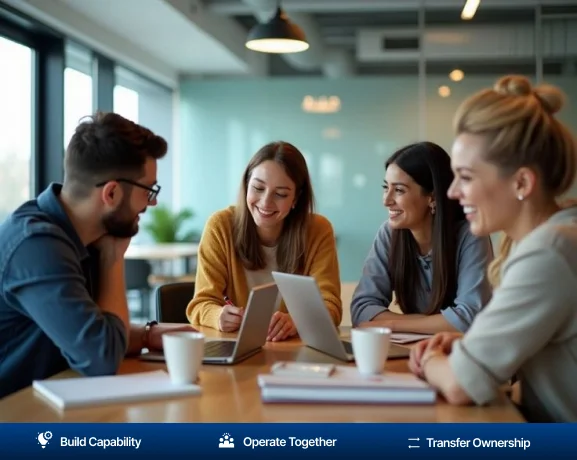
Build Capability Inside Your Business
Your team works on your systems, standards and priorities from the beginning.
Reduce Day-One Operating Complexity
NetSet Software manages the agreed hiring, people and operating layer while you build capability.
Take Ownership With Evidence
Understand team performance, operating requirements and economics before assuming full responsibility.
HOW IT WORKS
Build. Operate. Transfer.
Each stage has a clear objective, defined responsibilities and a review point.
Your product and engineering leadership remain involved throughout the journey, supported by our outsourcing partner solutions.
- Stage 01
Build
Establish the capability.
Define the team, operating model, infrastructure, governance and long-term ownership plan.
You approve- Team
- Operating Model
- Budget
- Ownership Roadmap
- Stage 02
Operate
Run the centre and build readiness.
NetSet Software manages the agreed local operating layer while your organisation retains engineering control and builds the capability required for ownership.
You review- Engineering
- Team Health
- Costs
- Readiness
- Stage 03
Transfer
Move the agreed capability to your organisation.
Transition the agreed knowledge, operating responsibilities, assets and other defined elements once readiness conditions are met.
You accept- Knowledge
- Responsibilities
- Agreed Assets
- Operating Capability
- Engineering Performance
- Operating Stability
- Transfer Readiness
BOT is working when your bot outsourcing development team performs today and your organisation becomes more ready to own it tomorrow.
Want to validate engineering fit first?
Start with an Engineering PilotTHE OWNERSHIP QUESTION
Define exactly what becomes yours.
A BOT programme for bot software development teams should define the transfer scope from the beginning. The objective is simple: both sides know what moves, what remains outside the transfer and what requires a separate arrangement.
Legal-entity ownership, where relevant, must be specifically structured as part of the BOT model.
Transfer is defined at the beginning, not negotiated at the end.
TIMING AND CONDITIONS
Transfer when the operation
is ready to become yours.
A target date matters. Readiness matters more. Our BOT development services ensure ownership moves only when your organisation can successfully receive and operate the agreed capability.
-
Operating Structure Ready
Required employment, entity and operating arrangements are in place for the agreed model.
-
Leadership Ready
Named leaders are prepared to assume engineering, people, operational and financial responsibilities.
-
People & Contracts Ready
Agreed people, supplier, tool and asset transition plans are resolved.
-
Handover Ready
Documentation, access, open issues and responsibilities pass the agreed readiness review.
The BOT agreement defines how changes to the target transfer date are handled.
THE FULL FINANCIAL PICTURE
Understand the economics of
the complete journey.
The commercial model should account for the team, local operations, infrastructure, transfer activity and the cost of running the capability after ownership.
- Build Cost
- Operating Period
- Transfer
- Owned Operation
The value of working with a BOT development company is not simply lower cost. It is control, capability ownership and reduced long-term dependency.
WHY NETSET SOFTWARE
Engineering depth.
Local operating capability.
Ownership planning.
Build operate transfer IT outsourcing requires more than hiring. It requires engineering delivery, technical recruitment, local operations and disciplined transition planning. NetSet Software brings those capabilities together in one operating model.
Engineering Delivery
Technical Hiring
Local Operations
Senior Leadership Access
Selected outcomes
Long-term teams, built to last.
Embedded engineering teams and managed relationships we have built, run and grown over the long term.


Keeping 100+ vehicles moving, nine years running
Dispatch, pricing and delivery visibility in one connected platform.
Read the case study

Building, operating and transferring a 12-person team
Medical, entertainment and crew workflows on one shipboard platform.
Read the case study

Five engineers, two fintech modules, one shared programme
Fuel Cards and Nomad Pay, delivered through a Build–Operate–Transfer engagement.
Read the case study

Retail POS, built and kept moving forward
Counter software connected to hardware, from kiosks to handhelds.
Read the case studyFAQs
Clear answers before
you build.
A Build–Operate–Transfer model allows a company to establish engineering capability in India with the support of a local operating partner and move toward ownership over time. The partner helps build the team and operating structure, manages the agreed local responsibilities during the operating phase, and prepares the capability for transfer. Product direction, engineering standards and technical decisions can remain with the client throughout the journey.
A Managed Engineering Centre can remain a long-term partner-operated model, with the client retaining engineering control while the local operating partner manages agreed responsibilities around the team. A Build–Operate–Transfer model is designed with an additional objective: preparing agreed capabilities for eventual client ownership. The key difference is therefore not how the engineering team works day to day, but whether a defined transfer and ownership path forms part of the engagement.
The transfer scope depends on the structure agreed at the beginning of the engagement. It may include engineering knowledge, documentation, operating processes, agreed equipment, selected supplier arrangements and defined operational responsibilities. Employee transition and legal-entity ownership require separate planning and may depend on the agreed structure, applicable requirements and individual acceptance. The important principle is that the intended transfer scope should be clear before the centre is built.
Not necessarily. One reason companies consider a BOT model is to begin building engineering capability before establishing every local function themselves. The operating structure can be designed around the company's objectives, scale and ownership roadmap. If a client-owned legal entity becomes part of the long-term model, its timing and role should be planned separately rather than assumed to be required from day one.
There is no universal transfer timeline. The right timing depends on team scale, operating maturity, leadership readiness, knowledge transfer, contractual arrangements and the client's ability to take over the agreed responsibilities. Rather than choosing a date in isolation, the BOT plan should define readiness conditions and review points. This allows the transfer decision to be based on whether the operation is genuinely ready for ownership.
Yes. A company can begin with a dedicated engineering team, Engineering Pilot or Managed Engineering Centre and move toward a BOT structure once long-term ownership becomes a clear strategic objective. Starting smaller can help validate engineering quality, collaboration and the India operating model before committing to a broader ownership journey. Once BOT becomes the goal, the transfer scope and operating roadmap should be defined explicitly rather than assumed.
PLAN BEFORE YOU COMMIT
Tell us what you want to own.
We'll design the path to get you there.
Tell us the engineering capability you want to build and what long-term ownership should look like, whether you're comparing offshore delivery with onshore outsourcing. We'll help structure the operating model, transfer path and economics around that goal.